
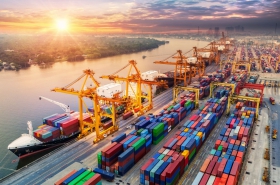
According to the Vietnam Association of Seafood Exporters and Producers (VASEP), by 2022, Vietnamese pangasius has conquered more than 140 markets around the world, including traditional and demanding markets such as the US, EU and Even markets that don’t like farmed fish like Japan. With an export turnover of 1.5-2.4 billion USD/year, pangasius accounts for 16-26% of Vietnam’s total seafood export value.
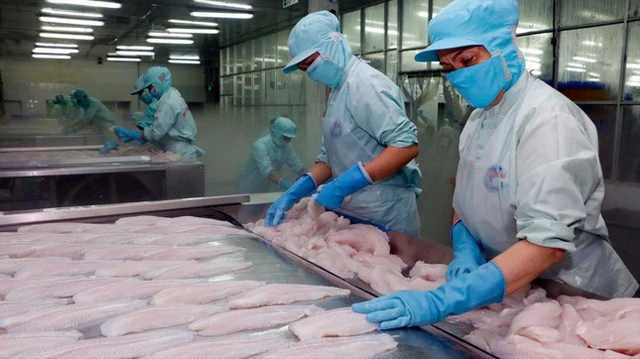
Processing pangasius for export. PHOTO: WARNING
However, exported pangasius products are mostly in the form of preliminary processing, while the proportion of deeply processed and value-added products (VAT) is still too modest. Specifically, in the structure of pangasius export products in 2022, frozen pangasius fillets accounted for 86%; fresh/frozen/dried pangasius whole, cut into pieces 12%; and processed pangasius only accounted for 2%.
After 20 years of successfully conquering many large markets, Vietnamese pangasius is still limited in the segment of value-added products. Mr. Tran Van Hung (Hung Ca Co., Ltd.) said that some businesses also invested in processing plants for the value-added product segment, but the operating results were not as expected. In addition, a notable factor is that value-added products when brought to the import market do not retain their integrity in terms of quality.
“Like the fake pangasius with lamb meat rolls, when brought to the import market, it broke down and did not meet the quality requirements. Meanwhile, fillets and whole cut pieces are rudimentary product lines that are brought into restaurants or purchased by consumers for processing according to their own needs and preferences, “- Mr. It is very difficult to change much in the near future.
Market barriers
According to Mr. Nguyen Van Trieu – Chairman of the Board of Directors of Cafatex Seafood Joint Stock Company, the import market focuses on buying Vietnamese pangasius fillets and whole pieces because it is convenient for them to process many products. different products. Enterprises also want to increase the value of pangasius by entering the value-added product segment, but now only stop at breaded products with negligible output.
Mr. Vo Hung Dung – General Secretary of the Vietnam Pangasius Association said that the market is in need of fillets, whole pieces, and this segment still brings many benefits to businesses and farmers, so the product line This preliminary processing is still being selected by enterprises.
On the other hand, barriers in tax rates, hygiene checks or more stringent related standards of importing countries for deep-processed products are also obstacles for enterprises to promote this segment.
Loss of “unique” position
According to the Ministry of Agriculture and Rural Development, pangasius is an endemic aquatic species with economic value of the Mekong Delta region, it is also a national product and is included in the agricultural restructuring program. With the absolute advantage of natural conditions of the Mekong Delta, the pangasius industry is constantly developing and has now become a famous global pangasius industry.
However, after the first few years, there were no competitors, “only one market” because there was almost no competitive country, then later and especially in recent years, Vietnamese pangasius gradually lost its unique position. while countries such as India, Bangladesh, Indonesia and China have produced a significant amount of pangasius.
The Global Seafood Market Conference (GSMC) estimates that global pangasius production in 2023 will increase by 62,000 tons, to more than 3.4 million tons. In which, Vietnam accounted for 44% with more than 1.4 million tons; followed by India with 648 thousand tons; China 468 thousand tons; Bangladesh 412 thousand tons and Indonesia 387 thousand tons.
According to Deputy Minister of Agriculture and Rural Development Phung Duc Tien, in order to sustainably develop the pangasius industry, many synchronous solutions are needed such as linking and forming the value chain of the pangasius industry between farmers and businesses; planning of pangasius production areas and processing establishments; diversify products to add value, effectively use by-products and develop e-commerce; building brands and developing consumer markets including export and domestic consumption.